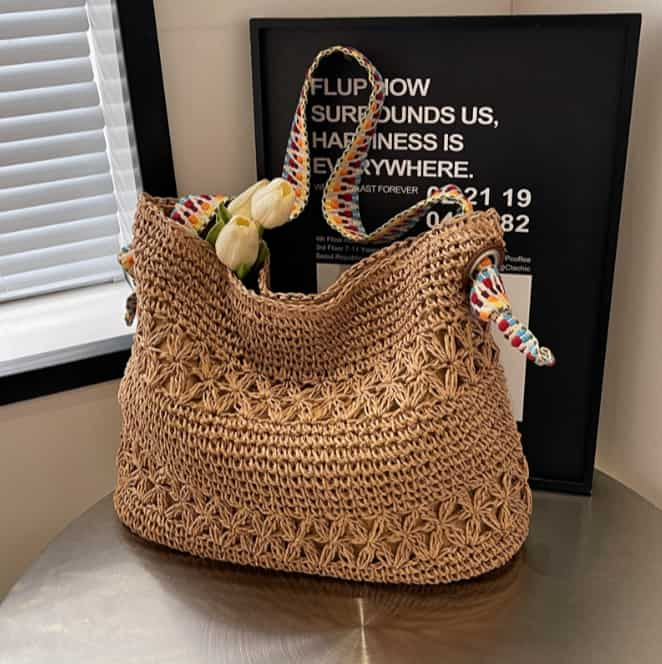
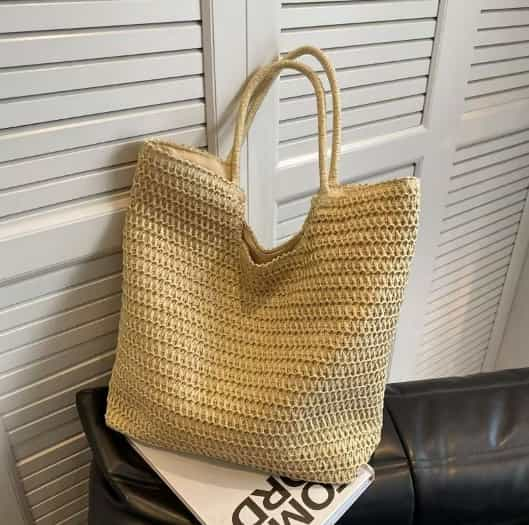
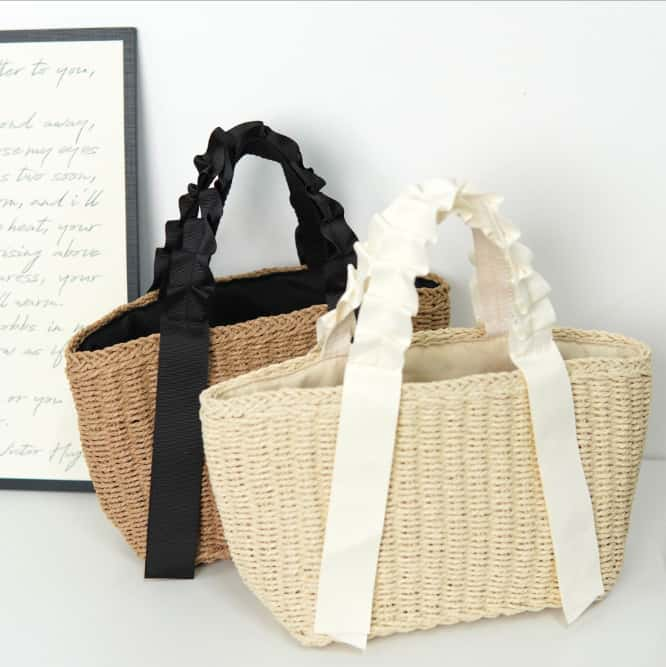
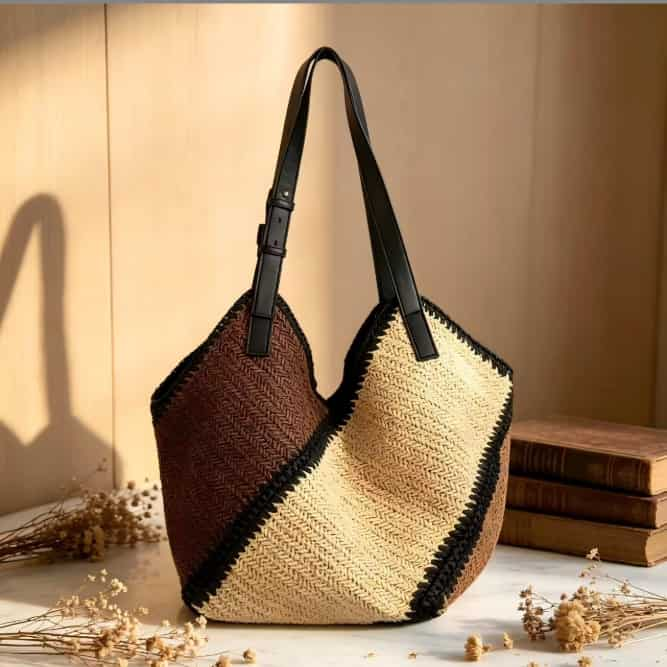
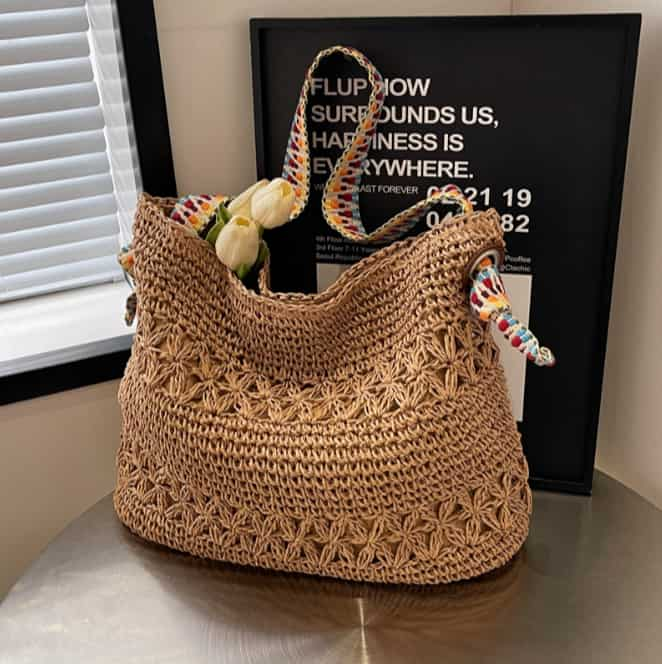
In OEM/ODM sourcing, sampling turns ideas into reality. A good sample protects you from production failures.
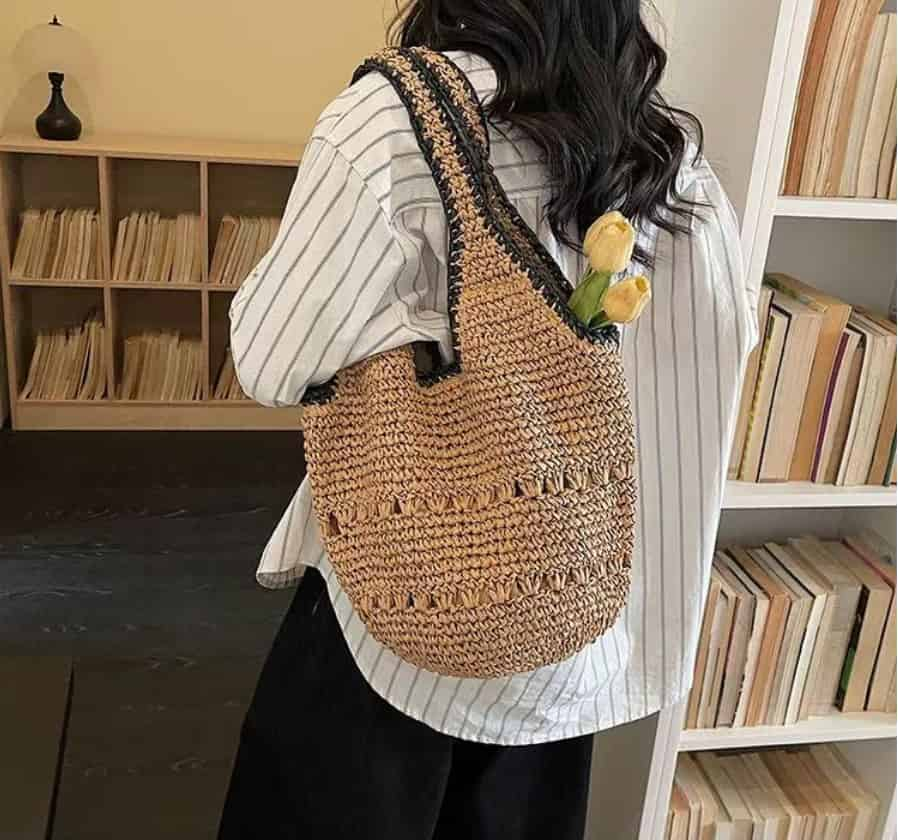
Raffia bags are different from fabric bags—they’re “assembled products” that need handles, linings, and hardware for support. Pure straw bags are fragile and limited to simple pouches.
So, how does the raffia bag sampling process work for OEM/ODM buyers? This guide covers everything from design confirmation to sealed samples.
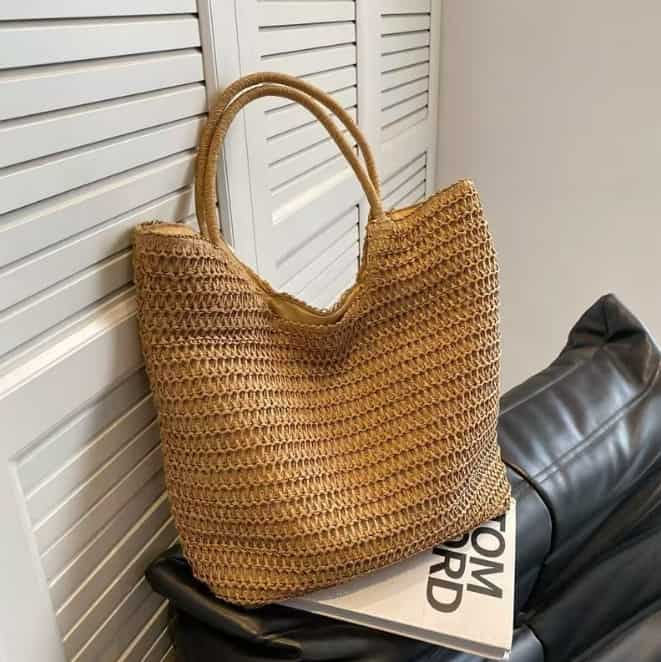
Understanding the Unique Nature of Raffia Bag Sampling
Why Does Raffia Bag Sampling Take Longer?
Raffia bag sampling typically takes longer than regular fabric bags. Based on industry experience, raffia bag samples require 7-10 days, while fabric bags usually take only 5-7 days. Some professional factories can offer “7-day rapid pre-production sample confirmation service.”
Reasons:
- Woven body requires external sourcing: The woven raffia body typically comes from specialized weaving workshops (hand or semi-hand woven), not produced directly in the factory
- Hand-weaving is time-consuming: A single raffia bag requires 2-3 days of hand-weaving labor. From material selection to crocheting, it requires “full concentration on every stitch, ensuring each knot is uniform in size and each stitch has equal tension”
- Multiple supply chain stages: From fiber procurement to weaving workshops to assembly factories, multiple stages require coordination. Raffia fibers must be “sourced from high-quality origin, using the most flexible middle section, with length controlled within 1.6 meters”
Sampling Cycle Reference:
| Bag Type | Sample Lead Time | Bulk Lead Time |
|---|---|---|
| Raffia Bag | 7-10 days | 30-45 days |
| Regular Fabric Bag | 5-7 days | 20-30 days |
Raffia Bags as “Assembled Products”
Raffia bags are not single-material products—they require a combination of multiple materials:
- Woven body: Raffia fibers (natural or synthetic), produced by specialized weaving workshops
- Structural support: Handles, linings, trims, fasteners
- Accessories: Leather handles, hardware, tassels, embroidery, etc. Customization options include “raffia weave density, tassel length and fullness, frame shape, handle wrapping techniques, lining fabric, and logo application”
This “assembled product” nature means sampling requires coordination across multiple suppliers and process stages.

The Complete Raffia Bag Sampling Process
Phase 1: Requirements Communication and Design Confirmation
Step 1: Define Product Requirements
Before formal sampling, buyers should provide the factory with the following information:
- Design files: Tech Pack, reference images, or reference samples
- Material requirements: Fiber type (natural raffia, synthetic raffia, blended, etc.)
- Dimensions: Bag size, handle length, lining requirements
- Quality standards: Target market (US/Europe, Middle East, Asia-Pacific) and corresponding quality grade
Material Selection Reference:
- Natural raffia: High-end, natural style, from Madagascar palm leaves, slightly textured but flexible
- Synthetic raffia (PP/polypropylene): Durable, waterproof, suitable for high-frequency use
- Paper raffia: Low cost, suitable for disposable or packaging use
Step 2: Design Feasibility Assessment
The factory’s design team evaluates the client’s design:
- Is the design suitable for raffia weaving techniques?
- Can the required weave density be achieved?
- Are accessories (leather, hardware) compatible?
Industry experience shows: “Stiffness = Yarn Rigidity × Weave Density”—relying on thick yarn alone is insufficient; “if stitches are too loose, even thick yarn will sag.”
Step 3: Preliminary Quotation
Based on the design assessment, the factory provides a preliminary quotation, including:
- Sample fee
- Estimated bulk unit price
- Minimum Order Quantity (MOQ)
Phase 2: Sample Production (Prototyping)
Step 1: Material Preparation
The factory prepares sampling materials based on design requirements:
- Raffia fibers (confirm color, thickness, grade). Dyeing uses specific techniques: “selected raffia is moistened before dyeing, using traditional pot-boiling methods, minimizing industrialized dyeing processes wherever possible”
- Lining fabric (cotton, linen, polyester, etc.)
- Hardware and accessories
- Leather or synthetic leather (if leather splicing is involved)
Step 2: Woven Body Production
This is the most critical and time-consuming stage of raffia bag sampling:
- The woven body is hand or semi-hand woven by specialized workshops
- Weave density must meet the required stitch count
- Production typically takes 3-5 days
The process includes: “after dyeing, sun-dry without direct exposure to harsh sunlight (which affects raffia flexibility), turning frequently to ensure even color on all sides.”
Step 3: Assembly and Accessory Installation
After the woven body is completed, assembly begins:
- Install handles, lining, hardware
- Complete trims and decorations
- Logo embroidery or label application
Step 4: Sample Inspection and Revision
After sample completion, internal inspection is conducted:
- Dimensions meet requirements
- Weave density meets standards
- Accessories are secure
- Overall appearance matches the design
If issues arise, corrections are made or the sample is remade.
Phase 3: Sample Approval and Sealed Sample Management
Step 1: Sample Shipment
After completion, samples are shipped to the client, typically including:
- 1-2 complete samples
- Attached color swatches and material descriptions
- Recommended to include a sample inspection report
Step 2: Client Feedback and Revisions
The client inspects the sample and provides feedback:
- Size adjustments
- Color corrections
- Detail improvements
Based on factory experience, most cases require 2-3 rounds of revisions to reach final approval.
Step 3: Sealed Sample Confirmation
After final sample approval, both parties sign the Sealed Sample Confirmation:
- The sealed sample serves as the quality standard for bulk production
- Bulk quality is based on the sealed sample
- Any modifications should be completed during the sampling stage
Phase 4: From Sealed Sample to Bulk Production
Step 1: Bulk Production Scheduling
After sealed sample confirmation, the factory schedules bulk production:
- Confirm order quantity
- Arrange woven body sourcing
- Set production schedule
Step 2: Bulk Production
Bulk production typically takes 30-45 days. “Standard bulk delivery time is 30-45 working days,” with “rush orders available to meet peak season demands.” During this period:
- The factory conducts in-process quality checks (random inspection every 50-100 pieces)
- Clients can arrange mid-production inspections
Step 3: Pre-Shipment Inspection
After bulk completion, pre-shipment inspection is conducted:
- AQL sampling inspection
- Packaging inspection
- Container loading arrangement
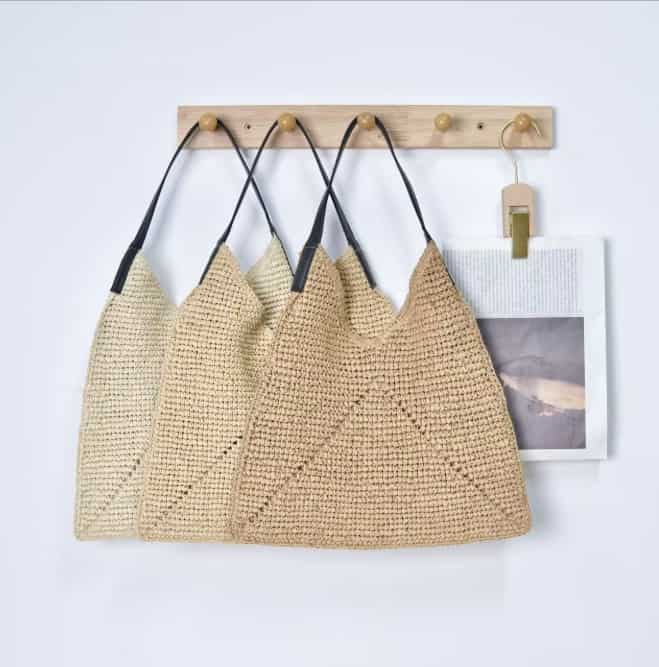
Key Quality Control Points During Sampling
Weave Density Control
Raffia bag shape retention depends on weave density. During sampling, focus on:
- Whether stitches per 10cm meet the standard (18-22 stitches recommended for 3mm raffia)
- Whether the base uses tight single crochet
- Whether the weave is even, with no visible gaps
- “Weave density is the soul! Never rush and loosen stitches just to meet deadlines”
Accessory Compatibility
Raffia bags are assembled products—accessory compatibility is critical:
- Are leather handles securely attached to the body?
- Is hardware quality and installation up to standard?
- Does the lining fit the body properly?
- “Reinforced stitching at frame edges prevents woven body tearing; polished anti-rust metal hardware maintains smooth operation even after long-term use”
Color Consistency
For dyed raffia bags, color consistency is a key validation item during sampling:
- Does sample color match client requirements?
- Is there color variation within the same raffia batch?
- Does colorfastness meet standards (dry rubbing ≥ Grade 4)?
Identification Tip: “Cut a strand of raffia—if the center is white while the surface is colored, it’s surface-dyed and will fade over time. Premium products use high-temperature, high-pressure penetration dyeing with consistent color throughout.”
Structural Integrity and Reinforcements
Beyond weave density, the overall structural integrity of the raffia bag determines its long-term durability:
Key Areas to Inspect:
- Handle attachment points: Where handles meet the woven body is the most stressed area. Check for reinforced stitching or hidden backing
- Edge finishing: Are edges cleanly finished with stitching or binding? Raw edges will fray over time
- Bottom reinforcement: Does the base have additional layers or a stiffener for stability?
- Stress points: All points where tension concentrates (handle connections, corners, hardware attachments) should show extra reinforcement
Testing Methods During Sampling:
- Hang the empty bag with a 3kg weight in it for 2 hours—check for deformation or seam separation
- Pull handles in opposite directions—check for loosening at attachment points
- Open and close zippers/hardware 20-30 times—check for smooth operation and wear
- Fold the bag along its natural crease lines—check for fiber cracking or white stress marks
Common Reinforcement Techniques:
- Leather patches at handle attachments
- Double-stitched seams at high-stress areas
- Hidden cardboard or plastic stiffeners in the base
- Fabric backing on the inside of the woven body
Dimensional Accuracy and Tolerance Check
During sampling, dimensional accuracy must be verified against the design specifications:
Measurement Points:
- Overall bag height (including handles)
- Bag body width (at widest and narrowest points)
- Bag depth/width (base measurement)
- Handle drop (distance from top of handle to bag opening)
- Interior dimensions (lining fit)
- Hardware placement positions
Acceptable Tolerances:
| Measurement Type | Acceptable Tolerance |
|---|---|
| Body width/height | ±0.5cm |
| Handle drop | ±0.5cm |
| Hardware position | ±0.3cm |
| Base depth | ±0.3cm |
| Lining size | Must fit without wrinkles |
Measurement Tips:
- Measure on a flat, hard surface
- Take measurements at three different points and average them
- Compare measurements against the original design Tech Pack
- Photograph measurement points for record-keeping
- If tolerances are exceeded, document and request revision
Sampling Fees and Policies
Sample Fee Collection Methods
Sample fee policies vary by factory:
| Factory Type | Sample Fee Policy | Notes |
|---|---|---|
| Simple designs | Free or low fee | Usually 3-5 free samples provided |
| Raffia/complex designs | Sample fee charged | Approximately 2x the unit price, refundable after bulk order |
| High-value custom designs | Charged at actual cost | Involves special materials, metal logos, etc. |
For OEM customization, factories typically require “custom designs based on provided artwork” or “customization on demand,” with some offering “design customization within 3 days.”
Sample Fee Refund Policy
Most factories refund or deduct the sample fee after bulk order placement:
- Sample fee fully deducted from the bulk order
- Usually requires the order to reach a certain amount or quantity
Sampling Timeline Planning Recommendations
Given the longer sampling cycle for raffia bags, buyers should plan ahead:
| Timeline | Recommended Action |
|---|---|
| 4-5 months before season | Initiate sampling process |
| 3-4 months before season | Complete sealed sample confirmation |
| 2-3 months before season | Place bulk order |
| 1-2 months before season | Bulk delivery |
Cost Breakdown of Sampling
Understanding the cost components of sampling helps buyers evaluate quotations:
Sample Cost Components:
- Material costs: Raffia fiber, lining fabric, hardware, leather, trims
- Labor costs: Pattern making, weaving, assembly, finishing
- Development costs: Design consultation, mold making (for custom hardware)
- Shipping costs: Courier fees for sample delivery to client
- Administrative costs: Communication, documentation, sample management
Sample Cost Estimation Reference:
| Cost Component | Estimated % of Total Sample Fee |
|---|---|
| Materials | 30-40% |
| Labor | 35-45% |
| Development | 10-15% |
| Shipping | 5-10% |
| Administration | 5-8% |
Cost-Saving Tips for Buyers:
- Combine multiple design variations into one sample batch to share shipping and handling costs
- Provide clear, detailed specifications upfront to reduce revision labor
- Consider digital sample visualization before physical production (3D rendering)
- Consolidate sample requests for multiple colorways into one production batch
Sample Ownership and Intellectual Property Protection
During the sampling process, ownership of designs and intellectual property should be clearly established:
Key Considerations:
- Who owns the sample design after production?
- Can the factory show the sample to other potential buyers?
- Are there non-disclosure agreements (NDAs) in place?
Recommended IP Protection Practices:
- Sign a Non-Disclosure Agreement (NDA) before sharing design files
- Include IP ownership clauses in the sampling contract
- Specify that the sealed sample and its design are the exclusive property of the buyer
- Restrict the factory from selling or reproducing the sample design for other clients
- Use watermarked or low-resolution images when sharing design concepts remotely
What to Include in the Sampling Agreement:
- Design ownership and IP rights
- Limitations on sample usage (e.g., “sample may only be used for the specified buyer’s production”)
- Return of all design materials upon project cancellation
- Confidentiality terms and penalties for breach
Buyer Sampling Communication Checklist
Items to Confirm with Factory Before Ordering
- What is the sampling lead time? (typically 7-10 days)
- How is the sample fee charged? Is it deductible from bulk orders?
- How many free revisions are provided?
- Can design feasibility assessment be provided?
- Is real-time communication (video/photo) supported during sampling?
Information to Provide to Factory During Sampling
- Design artwork or reference images (AI, PDF, CDR formats preferred)
- Detailed dimensions (length, width, height, handle length)
- Material requirements (natural raffia/synthetic raffia/blended)
- Color requirements (Pantone number or physical color swatch)
- Special process requirements (embroidery, woven patterns, etc.)
Items to Check During Sample Approval
- Weave density meets standards (check gaps against light)
- Bag shape is stiff (press test for rebound)
- Accessories are secure (handle pull test)
- Color is consistent (compare with color swatch)
- Lining fits properly (no wrinkles, no looseness)
Common Sampling Issues and Solutions5.4 Sample Approval Checklist — Comprehensive Template
A comprehensive sample approval checklist ensures no detail is overlooked:
Appearance & Aesthetics:
- Overall shape matches design specifications
- Color matches Pantone number or reference sample
- Weave pattern is consistent and even
- No visible defects (stains, loose threads, uneven areas)
- Hardware matches specifications (color, finish, branding)
Construction & Craftsmanship:
- Weave density meets standard (measure at 3 points)
- Handle attachments are secure (pull test)
- Lining is properly installed (no wrinkles, no exposed edges)
- Seams are reinforced at stress points
- Edge finishing is clean and secure
Materials & Components:
- Raffia quality matches agreed grade
- Hardware is correct type and finish
- Leather/trim quality matches specifications
- Zippers/snaps function smoothly
Functionality:
- Bag stands upright when empty
- Load test (3kg for 2 hours) shows minimal deformation
- Handles are comfortable to hold
- Closure mechanisms work properly
Packaging & Documentation:
- Sample includes all components (dust bag, care card, etc.)
- Color swatches and material samples are attached
- Sample inspection report is included
- Sample is properly packaged for return (if applicable)
The 3-2-1 Communication Rule for Sampling
To ensure smooth communication during the sampling process, follow the 3-2-1 Rule:
3-Way Confirmation:
- Buyer confirms design details
- Factory acknowledges receipt and understanding
- Buyer reviews acknowledgment and clarifies any misinterpretations
2-Day Response Policy:
- Respond to factory queries within 2 working days
- Factory provides updates within 2 working days
- Prevents delays from communication gaps
1 Decision-Maker:
- Assign one primary contact person on each side
- All communication flows through designated contacts
- Prevents conflicting information from multiple sources
Communication Best Practices:
Keep a record of all modifications in the Tech Pack
Use a shared project folder (Google Drive, Dropbox) for all files
Maintain a communication log with dates, decisions, and action items
Use structured templates for revision requests
Take screenshots or photos to illustrate feedback clearly
Confirm understanding after each major communication
Sample vs. Bulk Inconsistency
This is one of the most common issues in raffia bag sourcing. Reasons for differences between sample and bulk include:
Common Differences:
- Different weave density (sample denser, bulk looser)
- Color variation (sample vs. bulk dyeing batch)
- Hardware quality differences (sample uses premium hardware, bulk uses standard hardware)
Solutions:
- Request a “Sealed Sample Confirmation” during sample approval, detailing materials, density, color, and all key parameters
- Before bulk production, request a Pre-Production Sample (PP Sample)
- Clearly agree: bulk quality must match the sealed sample; otherwise, the factory bears rework or compensation costs
Sampling Communication Issues Leading to Repeated Revisions
Raffia bag designs involve many details—poor communication can lead to repeated revisions, extending the sampling cycle.
Common Communication Issues:
- Unclear design drawing annotations
- Inaccurate color descriptions (relying on verbal descriptions or phone photos)
- Vague revision requests (e.g., “tighter” rather than “stitch density must reach 20 stitches per 10cm”)
Solutions:
- Provide a complete Tech Pack with all information: dimensions, materials, colors, processes
- Use Pantone color cards for color communication—not verbal descriptions or photos
- Make revision requests as specific as possible: e.g., “reduce width from 30cm to 28cm”
- Request the factory to provide photos after each revision to confirm changes—avoid repeated sample shipping
Sampling Lead Time Delays
Raffia bag woven bodies require external sourcing, making sampling cycles susceptible to supply chain delays.
Common Delay Causes:
- Tight scheduling at weaving workshops
- Raffia fiber out of stock or color mismatch
- Accessory procurement delays (e.g., specific hardware)
Solutions:
- Confirm woven body scheduling with the factory in advance
- Choose common colors (beige, light brown) whenever possible to reduce material waiting time
- Start the sampling process 2-3 months in advance to allow buffer time
Sample Fee Disputes
Unclear sample fee collection and refund policies can easily lead to disputes.
Common Disputes:
- Client cancels after sample fee payment—is the fee refundable?
- Client unhappy with sample and requests re-sampling—who bears the additional cost?
Solutions:
- Clarify sample fee policy before cooperation: whether charged, whether deductible, and conditions for deduction
- Clarify the number of free revisions (recommended 2-3), with additional fees beyond that
- All fee terms should be confirmed in writing—avoid verbal agreements
Raffia Bag Sampling “Pitfall Avoidance Guide”
Avoid “Pure Straw Bag” Designs
As industry experts caution: “Pure straw bags have no reinforcement, are very fragile, and are limited to simple pouches.”
Design Recommendations:
- Raffia bag designs should include reinforcing elements like handles, linings, trims, or fasteners
- Pure straw bags (without reinforcement) are only suitable for small clutches or decorative pouches
- For everyday-use bags, at minimum, add lining and reinforced handles
Verify the Woven Body Supply Chain
Raffia bag woven bodies come from specialized weaving workshops—not directly from the factory. Buyers should confirm:
- Does the factory have stable weaving workshop partnerships?
- Can the weaving workshop’s capacity meet bulk demand?
- Is the weaving workshop’s quality consistently controllable?
If the factory cannot clearly explain the source of the woven body, proceed with caution.
Confirm Accessory Suppliers in Advance
Raffia bag accessories (leather, hardware, etc.) also need advance confirmation:
- Can accessory suppliers meet quality requirements?
- Will accessory procurement lead times affect bulk delivery?
- Are there backup accessory suppliers?
Request a Pre-Production Sample
After sealed sample confirmation and before bulk production, strongly recommend requesting a Pre-Production Sample (PP Sample):
Purpose of the PP Sample:
- Confirm all revisions have been implemented
- Confirm quality standards for bulk production
- Last chance for correction before bulk production
PP Sample Timing:
- After sealed sample confirmation, before bulk production begins
- Recommended to specify PP Sample requirement when placing the bulk order
Retain Bulk Production Samples for Comparison
During bulk production, ask the factory to retain 1-2 pieces per batch for ongoing comparison with the sealed sample:
Purpose of Retained Samples:
- Prevent quality deterioration during production
- Facilitate quick comparison during inspection
- Provide evidence in case of quality disputes
How to Choose a Reliable Raffia Bag OEM Factory
When selecting a raffia bag supplier, evaluate based on these dimensions:
| Evaluation Dimension | Key Points to Check |
|---|---|
| Weaving Supply Chain | Does the factory have stable weaving workshop partnerships? Can they provide independent woven body samples? |
| Sampling Capability | What is the sampling lead time? Is the sample fee policy transparent? |
| Quality Control | Is there a density inspection process? Is there a sealed sample management system? |
| Accessory Integration | Can the factory source accessories (leather, hardware) as a package? |
| Communication Responsiveness | Is communication smooth during sampling? Are progress updates provided on time? |
| Track Record | Are there successful cases for similar products? Can client references be provided? |

Summary
Raffia bag OEM/ODM sampling is a systematic process involving design assessment, woven body sourcing, accessory matching, and quality validation. Compared to regular fabric bags, raffia bag sampling has a longer lead time (7-10 days) and involves more stages, requiring closer communication and coordination between buyers and factories.
Key Takeaways
- Sampling lead time: Raffia bag samples take 7-10 days—longer than regular bags
- Assembled product: Raffia bags require woven body + handles + lining + hardware
- Woven body external sourcing: The woven body comes from specialized workshops—the critical sampling stage
- Quality control: Weave density, accessory matching, and color consistency are the three core areas
- Sample fees: Complex designs typically charge sample fees, refundable after bulk order
- Timeline planning: Start the sampling process 4-5 months before the sales season
- PP Sample: Strongly recommended after sealed sample confirmation and before bulk production
- Supply chain verification: Confirm the stability and capacity of weaving workshops and accessory suppliers in advance
One-sentence summary: Raffia bag OEM/ODM sampling—takes longer and is more complex than regular bags, but a successful sample is the best guarantee against bulk production failures.
Looking to source high-quality raffia bags?
Contact us for wholesale pricing or custom solutions—ideal for brand clients, boutique stores, and retailers.