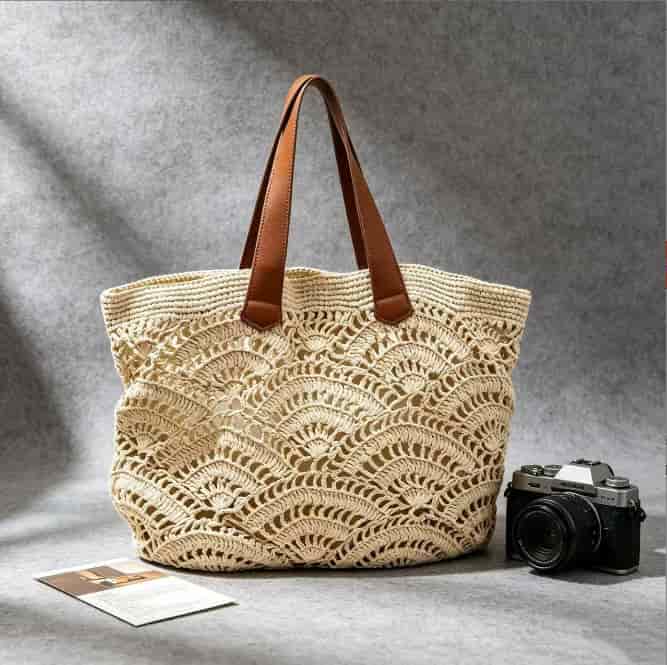
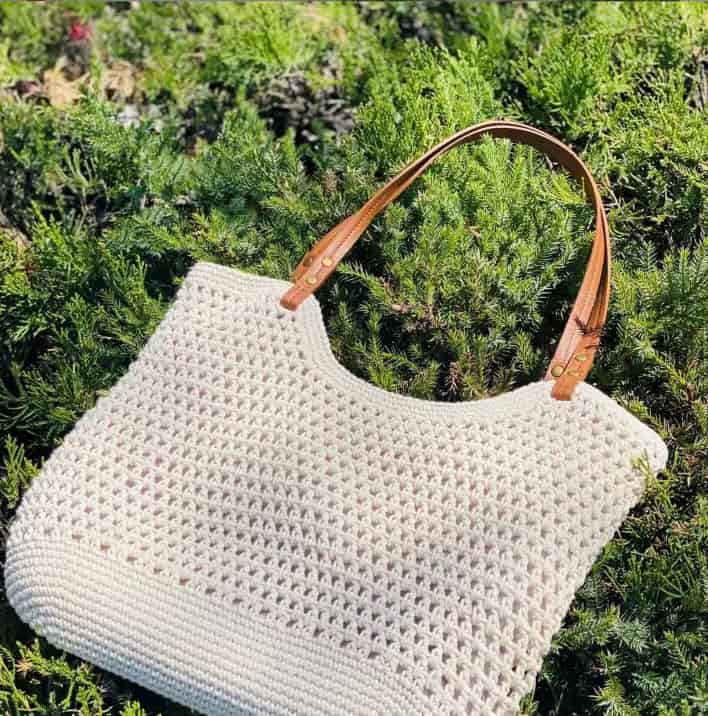
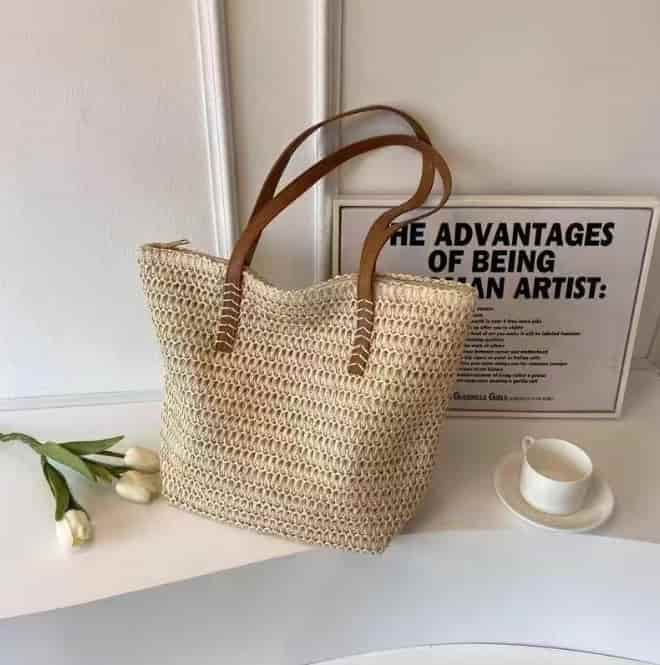
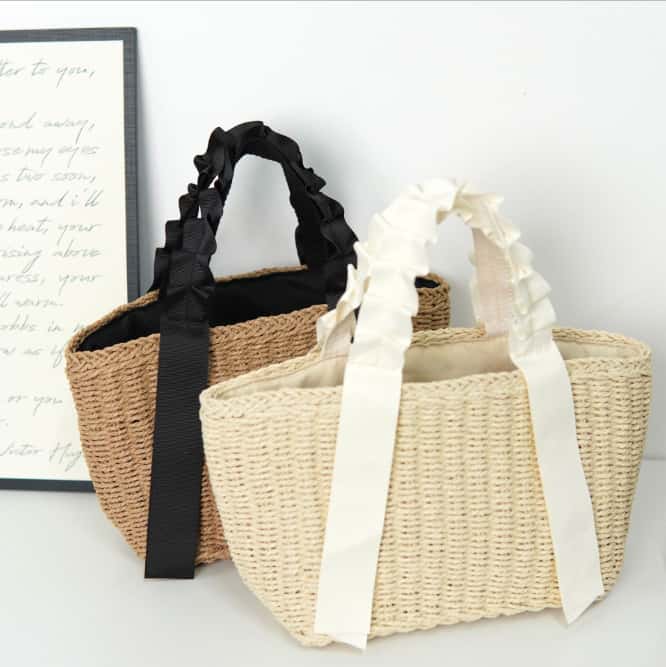
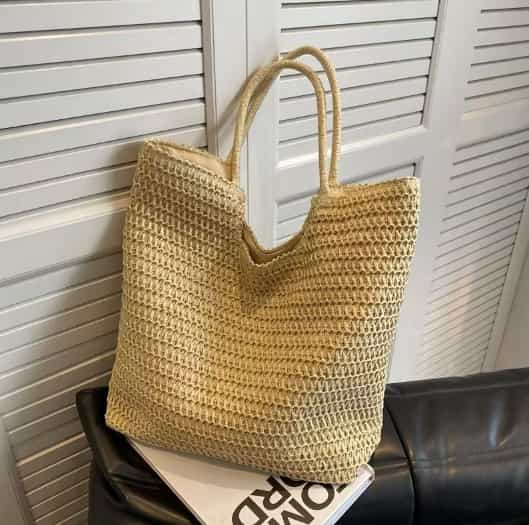
Here’s something that’s changed in the last couple of years. “Zero waste” isn’t just a niche concept anymore. It’s what customers actually expect.
And when it comes to bags, raffia is the material that delivers.
Zero waste fashion is about designing products that don’t leave anything behind. No plastic waste, no microplastics, no landfill forever. A compostable raffia bag fits that brief perfectly — it’s made from natural fibers, and when it finally wears out, it goes back to the earth.
If you’re a retailer or brand looking for a sustainable bag line that actually sells, here’s why raffia is the answer.
What Makes a Raffia Bag “Compostable”?
Let’s start with the basics.
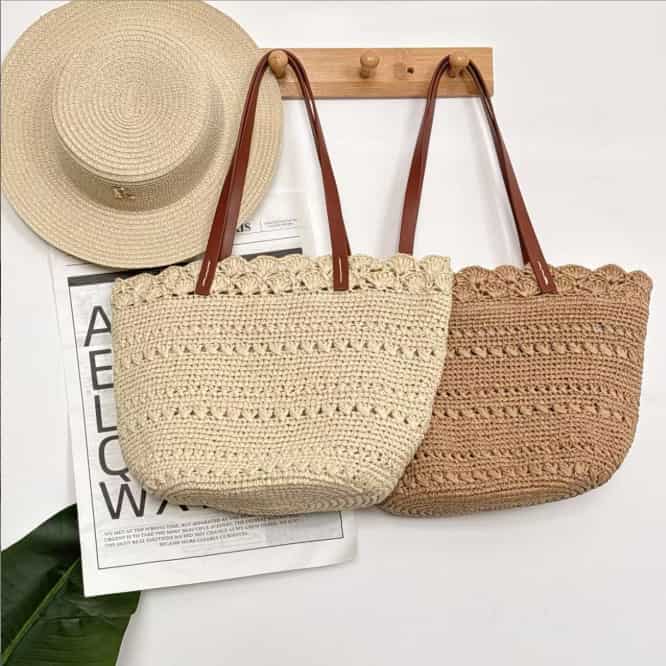
A compostable raffia bag is made from 100% natural raffia palm fiber — no synthetic threads, no plastic lining, no petroleum-based materials. It’s plant-derived, fully biodegradable, and designed to return to the earth at the end of its life.
Here’s what “compostable” actually means:
| Feature | What It Means |
| 100% natural fiber | Raffia from palm leaves — no synthetics, no plastic |
| No plastic content | Zero petroleum-based materials in the fiber, thread, or trims |
| Biodegradable | Breaks down naturally when composted |
| Non-toxic | No harmful chemicals — even the dyes can be natural |
| Returns to earth | No microplastics, no landfill forever |
The bottom line: A truly compostable raffia bag is 100% natural, non-toxic, and designed to return to the earth. No shortcuts, no hidden synthetics.
How Long Does Composting Take?
Here’s something customers often ask: “If I compost this bag, how long will it take to break down?”
The honest answer is: it depends.
What affects composting time:
| Factor | Impact |
| Bag thickness | Thicker weave takes longer |
| Dyes | Natural dyes break down faster than chemical ones |
| Compost conditions | Temperature, moisture, and oxygen levels matter |
| Home vs. industrial compost | Industrial compost is faster |
| Additional materials | Cotton lining takes similar time; leather or plastic doesn’t compost |
Estimated timeline:
- Home compost: 3–12 months for a thin raffia bag, up to 2 years for thicker weaves
- Industrial compost: 1–3 months
- Mixed materials (leather, hardware): Won’t fully compost — these need to be removed first
What to tell your customers:
“This bag is 100% natural raffia. It will break down in compost — but it’s also durable enough to last for years of regular use. Think of it as: lasts a long time, ends up as nothing.”
The bottom line: Compostable doesn’t mean “falls apart quickly.” It means “when it finally wears out, it doesn’t leave anything behind.”
What Your Customers Need to Know About Compostable Bags
Compostable raffia bags are durable, practical, and genuinely better for the planet. Here’s what your customers should know:
- Durable, not fragile – Raffia fibers are naturally strong and flexible. A tight weave with reinforced handles can handle laptops, groceries, and daily use for years.
- Composts best with heat and moisture – Industrial composting is ideal. Home composting works too but takes longer. Both need the right conditions — heat, moisture, and oxygen.
- Better than plastic, even in landfill – Even if not composted, raffia degrades faster than plastic without releasing microplastics or toxic residue.
- Made from a renewable resource – Raffia palms are pruned, not cut down. The tree keeps growing.
- No microplastics – Raffia breaks down naturally. Synthetic bags shed plastic particles forever.
The bottom line: These bags are built to last — and when they’re done, they return to the earth. Customers can feel good about that.
The Composting Process – What Actually Happens to a Raffia Bag
When a raffia bag is composted, it doesn’t just “disappear.” Here’s what actually happens.
The composting process step by step:
| Stage | What Happens | How Long It Takes |
|---|---|---|
| Microbial breakdown | Bacteria and fungi start breaking down the raffia fibers | 1–2 weeks |
| Decomposition | The fibers break down into smaller pieces | 1–3 months |
| Humus formation | The organic matter turns into nutrient-rich soil | 3–12 months |
| Full cycle | The bag has returned to the earth completely | Up to 12 months |
What the bag turns into:
- Nutrient-rich compost – Feeds plants and soil
- Carbon dioxide – Released into the air (natural part of the carbon cycle)
- Water – Returns to the soil
- Mineral residue – Natural minerals from the palm leaves
What doesn’t remain:
| What Doesn’t Remain | Why It Matters |
|---|---|
| Microplastics | Raffia is natural — it doesn’t leave plastic particles |
| Toxic chemicals | Natural raffia has no harmful chemicals |
| Petroleum residue | No petroleum-based materials |
| Non-degradable waste | Everything breaks down naturally |
The bottom line: Composting is not just disposal — it’s a return to the natural cycle. When a raffia bag composts, it becomes soil again. That’s what makes it truly zero waste.
What Makes Raffia the Ultimate Zero Waste Material
When you think about zero waste fashion, the material itself is the starting point. And raffia is about as close to “zero waste” as a material can get.
Why raffia fits the zero waste model:
- Nothing is wasted – The entire raffia palm leaf is used. The fibers are woven into bags, and the rest is composted or returned to the soil.
- No chemical inputs – Raffia doesn’t require fertilizers, pesticides, or irrigation. It grows naturally.
- Minimal processing – Sun-dried and handwoven. No chemical baths, no high-energy factories.
- Designed to return to the earth – When a raffia bag finally wears out, it composts naturally. No microplastics, no landfill forever.
- Supports communities – Handcrafted by artisans using traditional skills. No factory waste, no mass production.
How Raffia Compares to Other “Eco-Friendly” Materials
Not all sustainable materials are created equal. Here’s how raffia stacks up against other natural and synthetic alternatives.
Side-by-side comparison:
| Factor | Raffia | Cotton | Jute | Bamboo | Polyester (Recycled) |
|---|---|---|---|---|---|
| Renewable | Yes | Yes | Yes | Yes | No |
| Biodegradable | Yes | Yes | Yes | Yes | No |
| Water required to grow | Very low (rain-fed) | Very high (irrigation) | Low | Moderate | N/A (petroleum-based) |
| Pesticides needed | None | High | Low | Low | N/A |
| Processing energy | Very low (sun-dried) | High | Moderate | High | Very high |
| Microplastics shed | None | None | None | None | Yes |
| Soil regeneration | Yes | No | Yes | Sometimes | No |
| End of life | Compostable | Compostable | Compostable | Compostable | Landfill or downcycling |
Why raffia stands out:
- No irrigation needed – Raffia palms grow naturally in tropical climates with seasonal rainfall. Cotton is one of the most water-intensive crops in the world.
- No pesticides – Raffia palms don’t require chemical inputs. Cotton is heavily sprayed.
- Minimal processing – Sun-dried and hand-woven. Cotton requires ginning, spinning, and often chemical treatments.
- Soil health – Raffia palms actually improve soil structure and prevent erosion along riverbanks. Cotton depletes soil nutrients.
The bottom line: Raffia is one of the few materials that genuinely requires minimal intervention from nature to become a finished product. That’s what makes it a true zero-waste material.
Why Raffia Processing Uses So Little Energy
The environmental cost of a product isn’t just about the raw material — it’s about what happens to it after it’s harvested.
Raffia processing is remarkably simple:
| Processing Stage | Raffia | Cotton | Leather | Synthetic |
|---|---|---|---|---|
| Drying | Sun-dried | Machine-dried (energy) | Machine-dried (energy) | Melt-spun (high energy) |
| Chemical use | None | Bleaches, dyes, softeners | Chrome tanning (toxic) | Petrochemicals |
| Water use | None | Very high | Very high | High |
| Waste products | Plant matter (compostable) | Chemical runoff | Toxic sludge | Non-biodegradable waste |
| Energy source | Solar | Grid electricity | Grid electricity | Fossil fuels |
The bottom line: Raffia’s environmental impact is almost entirely from transportation and labor. The material itself carries a negligible carbon footprint because it requires so little energy to process. That’s why it’s considered a zero-waste material — not because of clever engineering, but because nature designed it that way.
The Full Lifecycle of a Raffia Bag – From Harvest to Compost
Raffia bags are circular by design. Here’s the complete journey.
The lifecycle timeline:
| Stage | What Happens | Why It Matters |
|---|---|---|
| Harvest | Leaves are pruned from raffia palms — tree keeps growing | Renewable, sustainable source |
| Preparation | Fibers are sorted, sun-dried, sometimes dyed with natural pigments | Minimal processing, low energy |
| Weaving | Artisans handweave the bag — 2–20 hours per bag | Supports traditional skills, fair wages |
| Use | Bag is used daily — lasts 1–3 years with care | Practical, durable, functional |
| End of life | Bag is composted — returns to earth in 3–12 months | No waste, no microplastics, no landfill |
The contrast with conventional bags:
| Stage | Raffia Bag | Synthetic Bag |
|---|---|---|
| Raw material | Renewable palm leaves | Petroleum-based plastic |
| Production | Sun-dried, handwoven | High-energy, chemical processing |
| Use | 1–3 years | 1–3 years |
| End of life | Composts naturally | Landfill forever + microplastics |
The bottom line: Raffia is one of the few materials that completes a full circle — from nature back to nature. That’s what makes it truly zero waste. And that’s a story your customers will connect with.
How to Identify a Truly Compostable Raffia Bag
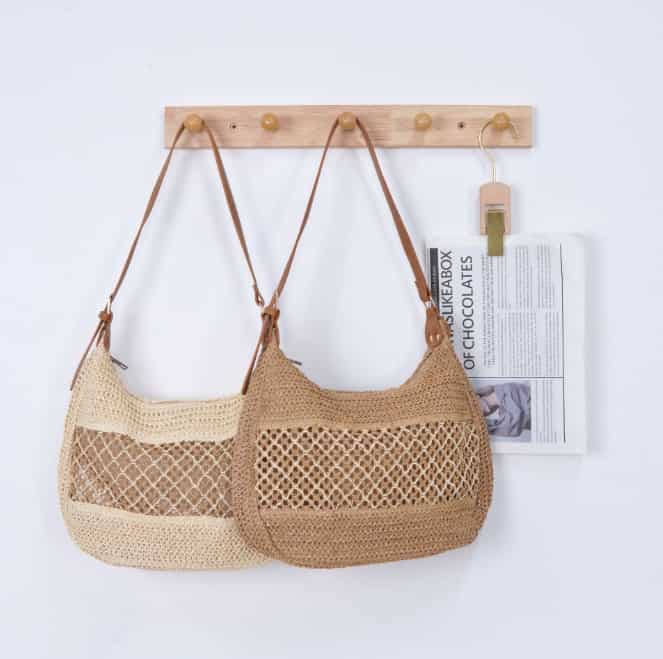
Not everything labeled “compostable” actually is. Here’s how to tell.
What to check:
| What to Check | What to Look For | What to Avoid |
| Fiber composition | “100% natural raffia” | “Raffia-effect,” “natural fiber blend” |
| Lining | Cotton or no lining | Polyester lining |
| Thread | Cotton or natural fiber | Polyester or nylon thread |
| Trims and hardware | Raffia, cotton, or untreated wood | Plastic zippers, PVC coating |
| Dyes | OEKO-TEX certified, natural dyes | Toxic chemical dyes |
| Packaging | Paper, cardboard, or compostable materials | Plastic polybags, bubble wrap |
The bottom line: Read the materials list. Ask your supplier for specifics. And don’t trust vague labels like “eco-friendly” or “natural blend.” If a bag is truly compostable, the supplier should be able to tell you exactly what it’s made of.
What a Compostable Raffia Bag Looks Like
You don’t always need a lab test to spot a genuinely compostable raffia bag. Sometimes, your eyes and hands are enough.
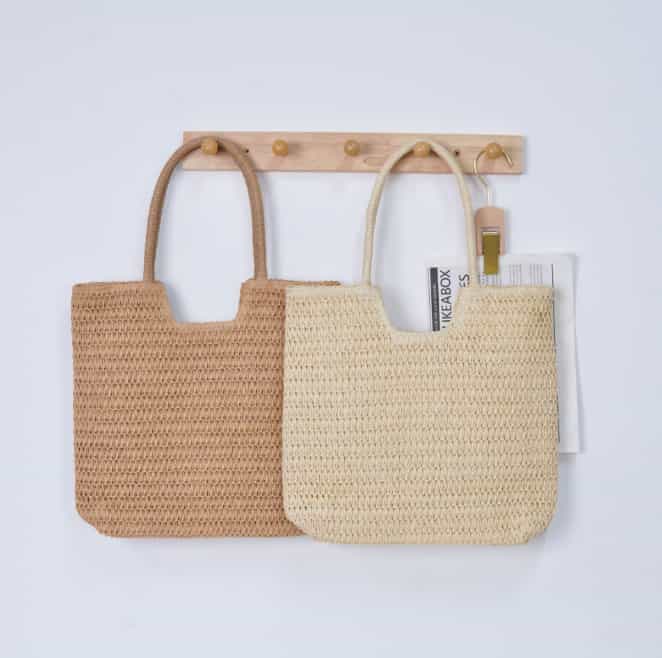
- Color – Natural raffia ranges from warm beige to honey brown. If the color is too uniform or looks “printed,” it may be dyed with synthetics.
- Texture – Slight irregularities in the weave are normal. If the weave is perfectly uniform, it’s more likely machine-made — which often means synthetic fibers are mixed in.
- Edges – Raw, unfinished edges are a good sign. Synthetic bags often have heat-sealed or melted edges to prevent fraying.
- Fraying – A little fraying is normal for natural raffia. If there’s no fraying at all, it might be coated with something.
The smell test:
- Natural raffia has a subtle earthy, plant-like scent.
- Synthetic or chemically treated raffia often smells like plastic, glue, or chemicals.
The water test:
- Drop a small amount of water on the bag. Natural raffia absorbs water slowly. Synthetic fibers repel water or bead up on the surface.
The burn test :
- Natural raffia: Burns like paper, smells like burnt leaves, leaves ash.
- Synthetic fibers: Melts, smells like plastic, leaves hard beads.
The bottom line: A truly compostable bag looks, feels, and smells natural. If it looks too perfect, feels too smooth, or smells like chemicals, it’s probably not 100% natural.
What Compostable Raffia Bags Cost and Why
Here’s a question I get a lot: “Why do compostable raffia bags cost more than regular ones?”
The answer is simple: real compostability costs more to produce. And the price difference tells you something important about what you’re buying.
What you’re paying for:
| Cost Factor | Why It Costs More | What You Get |
| 100% natural fiber | No synthetic blends allowed — raffia must be pure | A bag that genuinely breaks down |
| Natural or certified dyes | Natural dyes are more expensive than chemical ones | Non-toxic color that won’t harm compost |
| Cotton lining | Cotton costs more than polyester | A fully compostable bag — not just the outer layer |
| Cotton thread | Natural thread vs. synthetic polyester thread | No hidden plastic in the seams |
| Certification | OK Compost, EN 13432, or ASTM D6400 testing | Proof that the bag actually breaks down |
| Artisan labor | Handwoven by skilled artisans | Quality that lasts — and supports communities |
What a lower price usually means:
| Price Range | What You’re Getting |
| Under $3 wholesale | Likely a synthetic blend — not truly compostable |
| $3–6 wholesale | Mixed materials — some natural, some synthetic |
| $6–10 wholesale | Good quality natural raffia, but may have polyester lining |
| $10+ wholesale | Genuinely compostable — natural fibers, cotton lining, proper dyes |
The trade-off:
- You pay more upfront for a genuinely compostable bag.
- Your customers pay more at retail — but they get a product that actually delivers on its sustainability promise.
- You avoid the risk of greenwashing accusations and customer trust issues.
The bottom line: If a compostable bag is cheap, it’s probably not real. Real compostability costs more because it requires better materials, better dyes, and proper certification. If you’re selling a genuine zero waste product, your customers will pay for it — because they’re buying trust, not just a bag.
The Real Cost of Compostable Raffia Bags – Value vs. Price
Compostable bags cost more than synthetic alternatives. Here’s what you’re actually paying for — and why it’s worth it.
What you’re paying for:
| Cost Component | What It Includes | Why It Costs More |
|---|---|---|
| Natural raffia | 100% plant-based fiber | Natural materials cost more than synthetics |
| Artisan labor | Handwoven by skilled artisans | Labor is the largest cost component |
| Certification | OK Compost, EN 13432, or ASTM D6400 | Testing and certification add cost |
| Quality materials | Cotton lining, natural dyes | Premium materials cost more |
| Ethical production | Fair wages and safe conditions | Ethical production adds to cost |
The value comparison:
| Factor | Compostable Raffia Bag | Synthetic Bag |
|---|---|---|
| Wholesale cost | $8–15 | $3–6 |
| Retail price | $50–120 | $25–40 |
| Customer perception | Premium, sustainable | Budget, generic |
| End of life | Returns to earth | Landfill forever + microplastics |
| Brand value | Strong sustainability story | No sustainability story |
| Customer loyalty | High — customers come back | Low — customers buy the cheapest |
The bottom line: Compostable bags cost more to produce. But they sell for more, build stronger brand loyalty, and support a positive environmental story. The higher price is not a cost — it’s an investment in your brand’s future.
How to Market Compostable Raffia Bags to Eco-Conscious Shoppers
Compostable raffia bags are a sustainability story that sells itself — but only if you tell it right. Here’s how to reach the right customers.
What eco-conscious shoppers look for:
| What They Check | Why It Matters | What to Show Them |
|---|---|---|
| Certifications | Proof that your claim is real | OK Compost, EN 13432, OEKO-TEX logos |
| Materials | They want 100% natural, no synthetics | “100% natural raffia, cotton lining, natural dyes” |
| End of life | They want to know what happens when it’s done | “Compostable — returns to the earth” |
| Production story | They care about how it’s made | “Handwoven by artisans in Madagascar” |
| Packaging | They expect plastic-free shipping | “Packaged in recycled paper and cardboard” |
Marketing messages that work:
| Message | Why It Works |
|---|---|
| “100% natural raffia — biodegradable and compostable” | Clear, specific, believable |
| “Returns to the earth, not a landfill” | Emotional, visual, memorable |
| “Handwoven by artisans using traditional techniques” | Adds human connection |
| “No plastic. No synthetics. Just nature.” | Simple, honest, powerful |
Where to reach eco-conscious shoppers:
- Sustainable fashion platforms – Etsy, DoneGood, EarthHero
- Social media – Instagram and Pinterest for visual storytelling
- Email marketing – Share your sustainability story with subscribers
- In-store signage – Educate customers at the point of sale
The bottom line: Eco-conscious shoppers are your target audience. Tell the story clearly, back it up with certifications, and show them why compostable raffia is better for the planet. They’ll pay more and become loyal customers.
What Eco-Conscious Shoppers Actually Look For
Selling to eco-conscious shoppers is different from selling to the general market. Here’s what they actually care about.
What eco-conscious shoppers prioritize:
| Priority | Why It Matters | How Raffia Delivers |
|---|---|---|
| Transparency | They want to know exactly what they’re buying | 100% natural raffia — no synthetics |
| Certifications | They trust third-party verification | OK Compost, OEKO-TEX logos |
| End of life | They want to know what happens when it’s done | Composts naturally — no landfill |
| Origin story | They care where materials come from | Made from renewable palm leaves |
| Artisan story | They value human connection | Handwoven by skilled artisans |
| Packaging | They expect plastic-free shipping | Paper, cardboard, compostable materials |
What turns them off:
| Turn-off | Why It’s a Problem |
|---|---|
| Vague “eco-friendly” claims | Feels like greenwashing |
| No certifications | Can’t verify the claim |
| Plastic packaging | Contradicts the sustainability story |
| No artisan or origin story | Feels generic and mass-produced |
| Overpromising without proof | Breaks trust immediately |
The bottom line: Eco-conscious shoppers are informed and intentional. They do their research. Be honest, be specific, and show them proof — and they’ll become your most loyal customers.
How to Avoid Greenwashing When Selling Compostable Raffia Bags
Greenwashing is a real risk when marketing sustainable products. Here’s how to be honest and credible.
What greenwashing looks like:
| Greenwashing Example | Why It’s a Problem | What to Say Instead |
|---|---|---|
| “Eco-friendly bag” | Vague, unproven | “100% natural raffia — certified compostable” |
| “Biodegradable” | Without conditions or timeline | “Composts in 3–12 months in home compost” |
| “Sustainable materials” | Doesn’t say what or how | “Made from renewable raffia palm leaves” |
| “Plastic-free” | But packaging might have plastic | “Plastic-free bag and packaging” |
| “Natural fibers” | Could still have synthetics mixed in | “100% natural raffia with cotton lining” |
How to avoid greenwashing:
| Best Practice | Why It Works |
|---|---|
| Be specific | “100% natural raffia” not just “natural” |
| Show certifications | OK Compost, OEKO-TEX — logos build trust |
| Be honest about limitations | “Composts in 3–12 months in home compost” |
| Show the process | Behind-the-scenes photos of artisans and materials |
| Don’t overstate | Say what it does, not what you wish it did |
The bottom line: Honesty builds trust. Don’t exaggerate your compostability claims. Be specific, show proof, and your customers will reward you with loyalty and repeat purchases. Greenwashing damages your reputation — authenticity strengthens it.
Wrapping it Up
Zero waste fashion is more than a trend — it’s where the industry is heading. And compostable raffia bags are one of the smartest ways to get there.
They’re made from renewable natural fibers, handcrafted by artisans, and designed to return to the earth. No plastic, no microplastics, no landfill forever. Just a beautiful bag that tells a story customers actually want to hear.
Know your materials. Check your supplier. And sell a product that makes a difference.
Ready to add compostable raffia bags to your zero waste fashion line?
Contact Rafico Accessories for a custom raffia bag quote or wholesale pricing. We’ll help you find the right styles for your sustainable collection.